
A high taper fade on curly hair keeps the outline tight and the top full. The hair shortens fast around the temples, sideburns, and nape, then blends up into curls, coils, or waves that keep their length and weight. That contrast between a clean perimeter and a textured crown is why the high taper fade curly hair look is so popular with men in 2026, and why it carries across waves, coils, twists, and locs.
The name alone does not settle everything, though. Two barbers can hear the same request and cut two different results, because the term does not say how short the shortest point goes or how much of the side is faded.
The quick version
- “High taper” describes where the fade starts, not where it ends, so name the placement and the finish separately.
- The taper shapes only the outline. Top length, fringe, and silhouette are separate choices, and curls dry shorter than they measure.
- A skin, shadow, or guard-number finish changes scalp exposure and how fast the cut softens.
- A sharp high taper needs a refresh about every two weeks. Go by the softening temple line, not the calendar.
What is a high taper fade on curly hair?
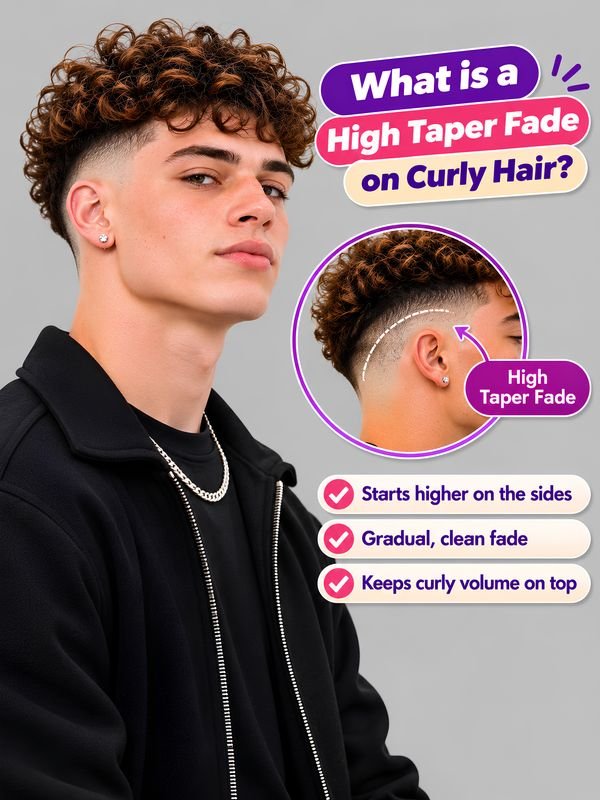
A high taper fade on curly hair shortens the hair quickly around the temples, sideburns, and neckline, then blends up into the curls on top. The fade zone sits high on the head but stays localized instead of sweeping across the whole side, so the upper sides keep more weight than a full high fade leaves behind.
Three things define the cut:
- The fade zone: the temples, sideburns, and nape, where the shortening happens.
- The blend: a gradual transition into the curly top, with no visible step.
- The shortest length: bare skin, a guard length, or a visible shadow.
That last point is the one people skip. Because “high taper” only describes where the fade begins, a reference photo tells your barber far more than the label does. Naming the finish clearly gives you a cleaner curly high taper fade haircut and far fewer surprises in the mirror.
High taper fade vs full high fade
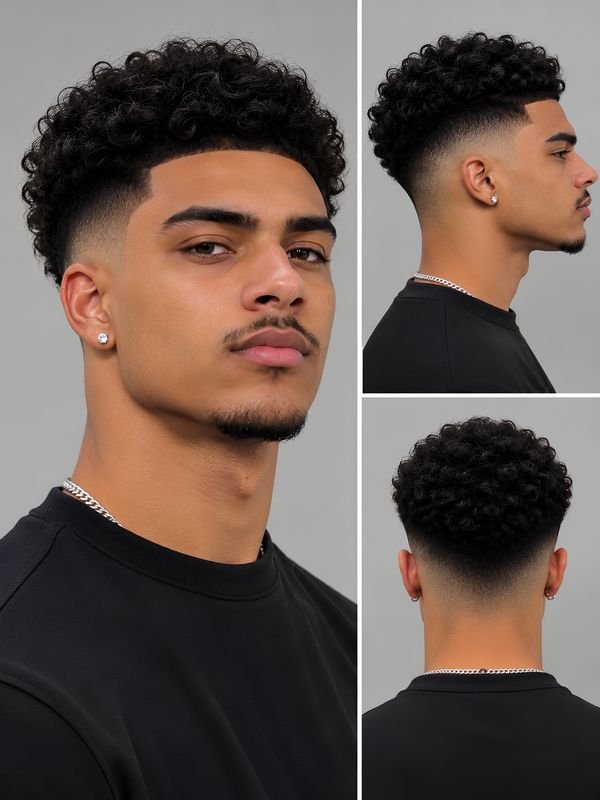
The difference comes down to coverage. A high taper fade concentrates its shortest cutting around the temples, sideburns, and nape and leaves more weight through the rest of the sides. A full high fade takes hair down across the whole side from roughly crown level, which gives a bolder and more exposed result.
Curls usually look fuller beside a taper, because the sides keep some body and the contrast stays focused on the edges. The vocabulary is also unsettled: some barbers reserve “taper” for cuts that never reach bare skin, while others happily cut a skin taper. That is why naming the fade zone and the finish matters more than getting the label right.
| Area faded | Temples, sideburns, nape | Entire side from crown level down |
| Feature | High taper fade | Full high fade |
| Side weight kept | More | Least |
| Contrast | High | Highest |
| Scalp exposure | Moderate, depends on finish | Highest |
| Best for | Sharp edges with fuller sides | Bold, exposed, high-contrast look |
Is a high taper fade right for your curly hair?
A high taper fade works on most curl textures, because the top style carries the curl pattern and the taper only shapes the outline. It suits you if you want sharp definition around the face without losing side fullness, and it works whether you wear a high taper fade with curls that are loose, tight, thick, or wavy.
- What you gain: a clean perimeter, curls that look fuller against shorter sides, and less bulk to manage day to day.
- What to weigh: more visible scalp near the fade, a sharper grow-out line, and a real dependence on your barber’s blending.
The trade-off is upkeep, since a high, high-contrast fade shows regrowth sooner than a lower one. The mistake that ruins this cut most often is over-thinning the top to “balance” the sides, which flattens the curls and removes the contrast that makes the style work.
Texture, density, and shrinkage

Curl pattern alone does not decide how this cut turns out. Looser, well-defined curls hold their shape at shorter top lengths and show a crisp line between the fade and the texture above it. Tighter curls and coils usually want a little more length on top, partly for silhouette and partly because thick, curly hair is more prone to dryness and breakage than other hair types. Fine hair can look sparse next to a high-contrast fade, while denser hair gives a sharper gradient.
Shrinkage deserves its own conversation before anything is cut. Curls spring back after trimming, so hair that looks like a #2 guard while stretched can dry much shorter. That is why barbers often go one guard longer on textured hair, and why you should judge the finished length on dry curls, not stretched ones.
Hairline, scalp exposure, and face shape

Fit depends more on the balance between top height and side width than on any fixed face-shape rule. A taller curly top adds vertical emphasis, which is why a high taper fade curly hair cut is often suggested for round faces, while oval and square faces suit most versions. Treat that as one input rather than a verdict, since stylists disagree about face-shape rules.
Two decisions matter more in practice. A receding or uneven hairline can be worked around by softening the front edge instead of cutting a hard line-up. And if you are unsure about exposed skin, a shadow finish shows less scalp than a skin taper while still giving you strong contrast.
What to decide before you book
Four decisions prevent most high taper fade misunderstandings, and all four are quicker to settle before the cape goes on than after the clippers start. Most disappointing cuts come from one detail left to the barber’s guess, such as how high the fade starts or how short the sides end.
Think about your routine too. A curly high taper fade haircut with a skin finish needs frequent touch-ups, while a shadow or guard finish grows out more gently and suits a low maintenance schedule. If you plan to grow a beard or work somewhere with a strict grooming code, mention it at the start so the edges can be planned around real life.
- Placement: high and focused on the temples and nape, or extended further across the side.
- Finish: skin, a specific guard number, or a soft shadow at the shortest point.
- Top shape: rounded curls, a forward fringe, a curly afro, or a fuller high-volume top.
- Edges: a natural soft edge or a sharp line-up, and whether the sideburns join a beard.
Must Read This 15 Best Taper Fade Designs: Lines & Patterns for 2026
Best high taper fade styles for curly hair
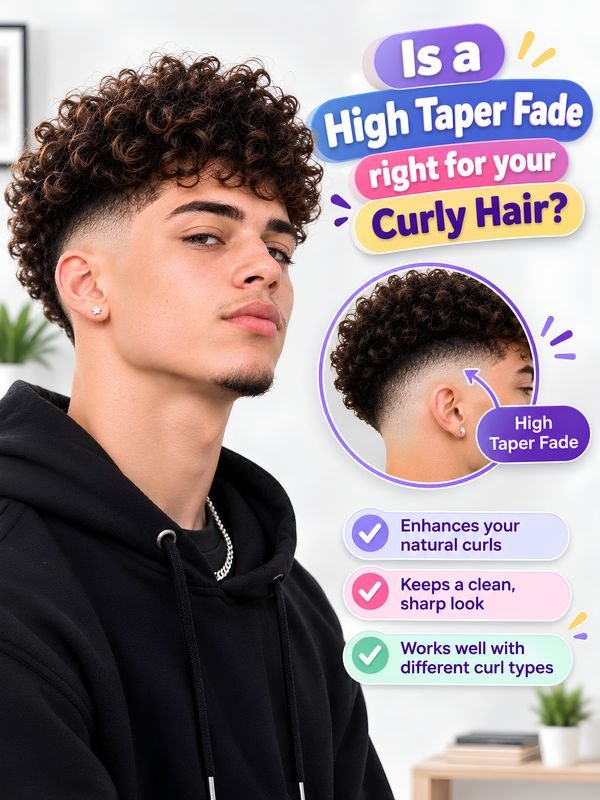
The styles below change the top shape, the finish, and the edge detailing rather than the taper itself. That means you can keep the same clean sides and still get a very different look, from a cropped cut to a full curly afro. Pick by top length, curl density, and how much contrast you want.
There are ten options here, covering short, medium, and long curly hair, natural curls, tight curls, and loose curls. Each works for teenagers and adults, and most can be adapted into a high taper fade curly hair cut for boys by keeping the sides a little longer. Read the barber tip under each one, because the words you use in the chair decide how close the result gets to your photo.
Short defined curls

This is the lowest-effort version, and one of the best choices for high taper fade short curly hair. The top stays short enough that individual curls or coils hold their shape with very little product, and the taper gives the whole outline a close-cropped finish. It works best on denser curl patterns, where short length still reads as texture instead of flatness, and it pairs naturally with a crisp line-up since there is little top volume competing with the edge.
Tell your barber: “Keep the top short but leave the curl pattern visible, and give me a crisp line-up.”
Medium curly top with a textured fringe
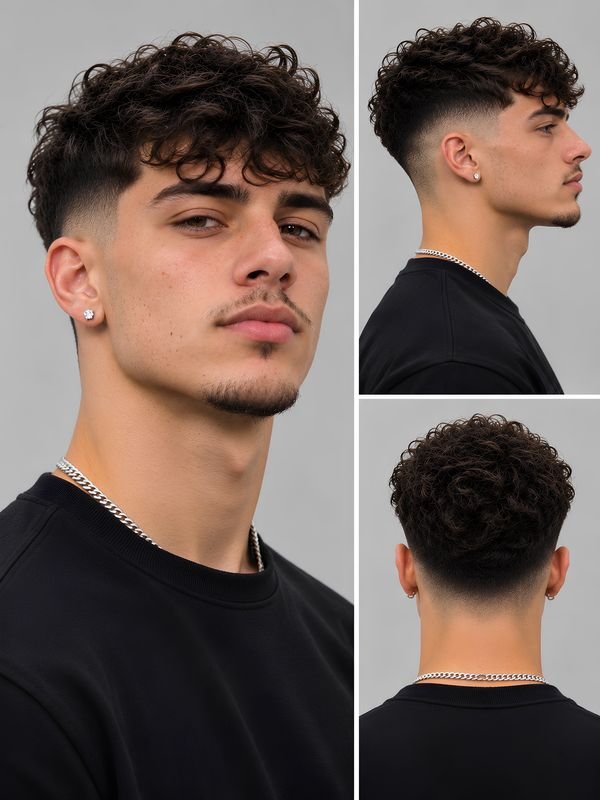
Leaving extra length on top opens up a forward fringe and lets the curl pattern move. A medium curly top with a textured fringe suits loose curls and wavy texture especially well, and it is a popular high taper fade curly fringe for teenagers. This is where shrinkage bites hardest, since a fringe that looks right while stretched can dry noticeably shorter. A softer perimeter usually suits this length better than a hard skin finish.
Tell your barber: “Leave the fringe a little longer than it looks, because it will shrink.”
Coily or afro top with a high taper
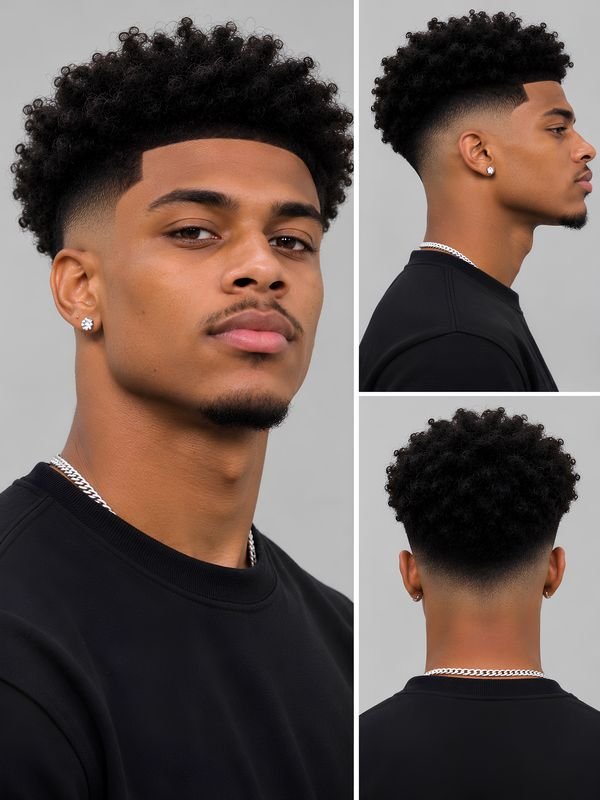
Here the taper frames the top instead of replacing it. This is a favorite high taper fade curly afro option for black men, because coily hair holds up well against sharp side contrast and keeps its volume above it. Most barbers leave fairly even length for a rounded silhouette, or shorter uneven layers for a looser finish. Keep shape-up work at the edges, since heavy thinning through the crown flattens the volume that makes the cut work.
Tell your barber: “Taper only the outline and don’t thin the crown.”
Blowout taper with longer curls
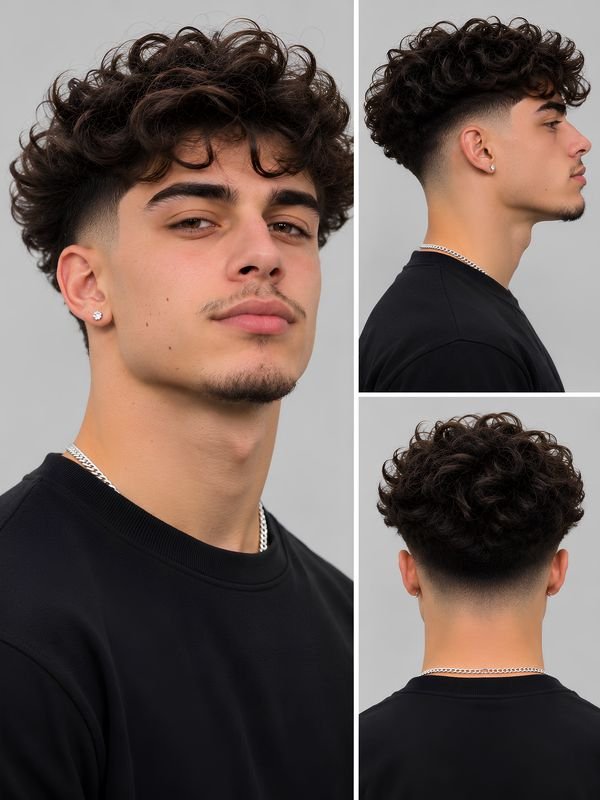
This style pairs a high, clean taper with a top that is blow-dried or diffused upward for height. It is the go-to for high taper fade long curly hair, and natural curls supply some lift without much effort. You need a couple of inches or more on top when stretched, so it is a poor choice in the middle of a short grow-out. Use a diffuser on low heat and a heat protectant to keep curls smooth.
Tell your barber: “I want height on top, so keep the length and clean up only the sides.”
High taper with a line-up or beard blend
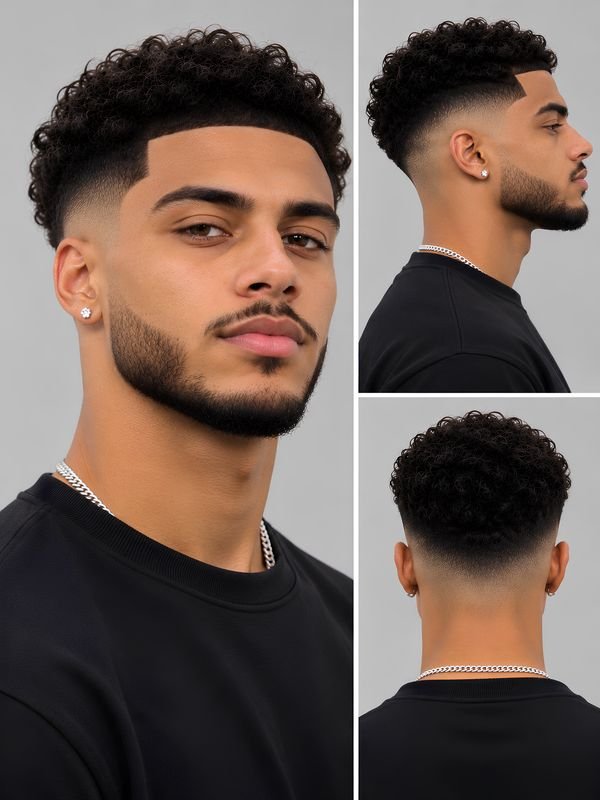
Edge detailing changes how sharp the cut looks without touching the top at all. A natural edge follows your hairline for a softer finish, while a crisp line-up suits shorter tops with less curl movement to soften it. For a high taper fade curly hair with beard, barbers commonly taper the sideburn into the beard using the same guard or one step longer, then clean the cheek line separately. Line-ups lose sharpness fastest, so expect quick edge trims between full cuts.
Tell your barber: “Blend my sideburns into my beard, then clean the cheek line.”
High taper with twists or a twist-out
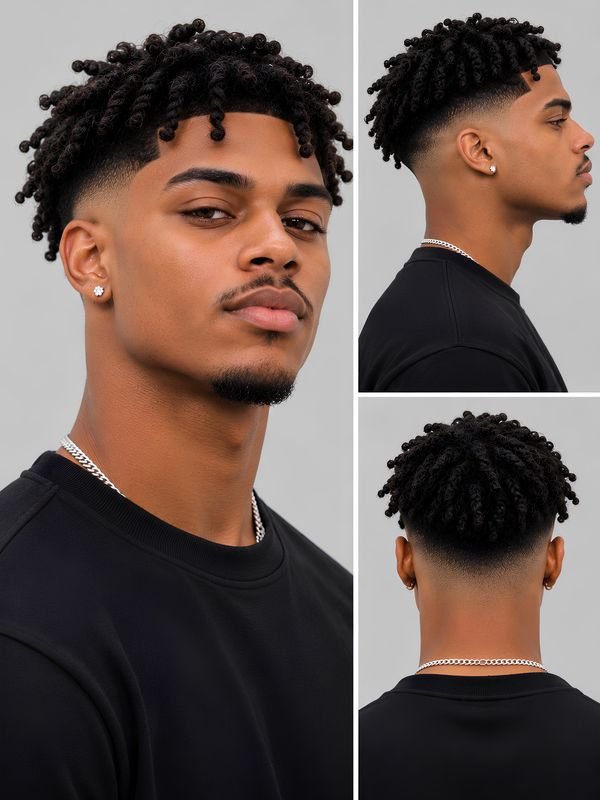
Twists add structure and definition to coily and tight curls, while the taper keeps the sides neat so the top stands out. You need at least three inches of length on top, and the style works as a short-term set or a twist-out for looser, defined curls. Retwist every one to two weeks and keep the scalp moisturized, and avoid pulling too tightly at the hairline.
Tell your barber: “Taper the sides high and leave the top untouched so I can twist it.”
High taper with a curly mohawk
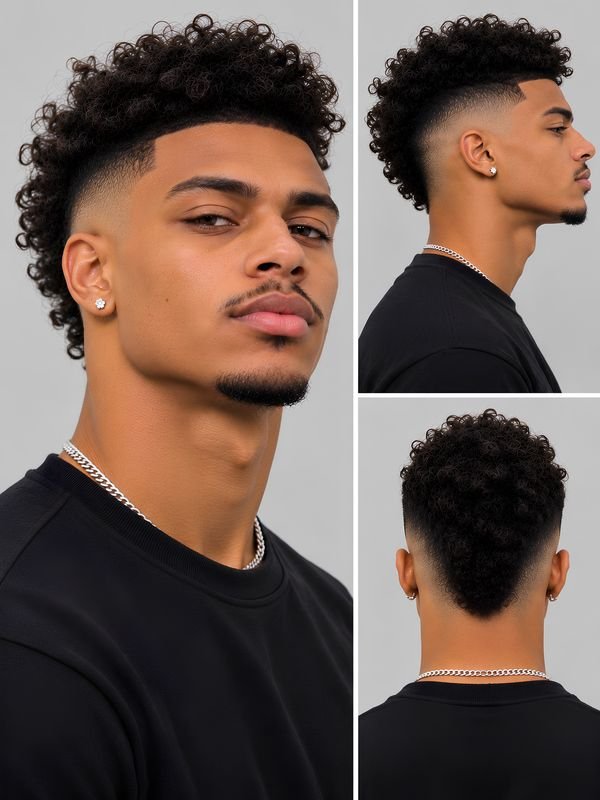
A curly mohawk, sometimes called a faux hawk, keeps the sides tight and raises the center for a strong vertical shape. It suits medium to thick curls with enough top length to build height, and the high taper makes the center strip stand out sharply. A light-hold curl gel keeps the shape through the day. The contrast shows regrowth quickly, so refresh the sides often.
Tell your barber: “Taper both sides high and blend the center strip upward.”
High taper with a razor part or design

A thin razor part or a small shaved pattern adds personality to a short or medium curly top without changing the taper itself. This high taper fade curly hair design works best when the line stays clean and simple, such as a single part or a minimal shape near the temple. Fine lines blur within days, so plan a quick touch-up every one to two weeks, and avoid repeated passes over the same close-cut skin to reduce irritation.
Tell your barber: “Keep the design small and clean, and show me how it grows out.”
High taper with dyed or bleached curls
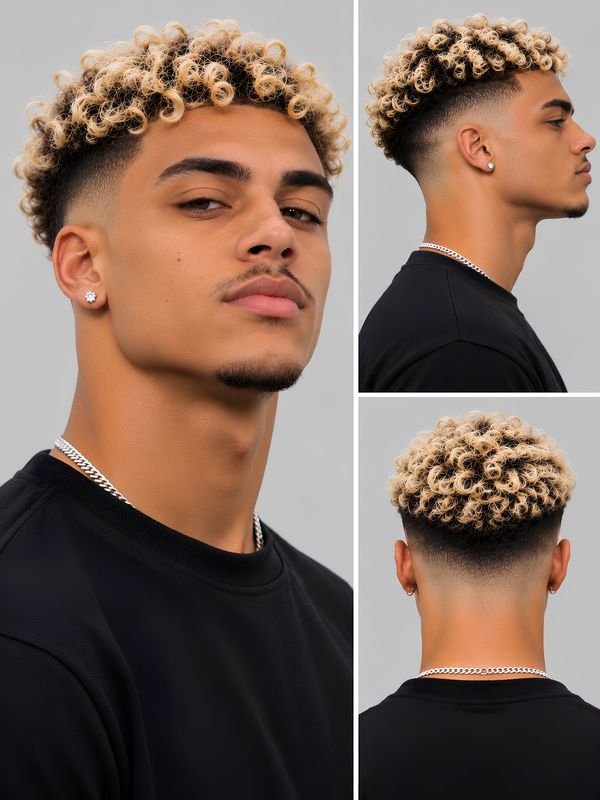
Color on top stands out sharply against dark, tight sides, which is why dyed curls are one of the boldest ways to wear a high taper fade with a curly top. Healthy curls with no existing breakage handle color best, and a professional colorist should do the work. Bleaching dries curls and loosens the pattern, so deep condition weekly and use a bond-repair treatment if your colorist recommends one. Root regrowth also shows sooner against a tight fade.
Tell your barber: “Taper the sides first, then color only the top.”
Must Read This 12 Best Mid Taper Fade Mullet Styles for Men (2026)
High taper with a curly quiff

A curly quiff lifts the front of the top up and back, which gives height at the hairline and a polished, forward-moving shape. It suits loose to medium curls with three to four inches of length, and the high taper keeps the sides sharp so the quiff stays the focus. Style it with a curl cream and a light-hold gel, and use a diffuser to lift the front. Because the front carries the whole shape, avoid cutting it too short.
Tell your barber: “Taper the sides high and leave the front long enough to sweep up and back.”
How to ask a barber for a high taper fade on curly hair
Describe the cut in parts instead of relying on the name. Say how much of the side should fade, how short the shortest point goes, what shape you want on top, and how the edges and beard should connect. Then bring photos so your barber can adapt the cut to your growth pattern rather than copying an image.
Try something like this: “I’d like a high taper concentrated around the temples and nape, keeping weight through the rest of the sides. Take the shortest point to a shadow, and leave the top at three inches with a textured fringe.”
The five-point request checklist
Settle the five points below before the clippers start, roughly in this order, so nothing gets decided by default mid-cut. Skipping any one of them is what produces a cut that comes out higher, shorter, or more disconnected from the top than you pictured.
On guard numbers, a #1/2 is about 1.5 mm, a #1 is about 3 mm, and a #2 is about 6 mm. Use a number for the shortest point only, because a taper runs through several lengths, and asking for “a number 1 on the sides” can lead a barber to cut one flat length instead of a blend. The same checklist works for a burst fade curly hair version, where the blend curves around the ear.
- Fade placement: temples and nape only, or extended across the side.
- Shortest length: skin, shadow, or a guard number, for the shortest point only.
- Top length and shape: curls, coils, fringe, afro, or a short cropped top.
- Temple and nape treatment: a soft tapered blend or a sharper defined edge.
- Line-up and beard: natural, lightly cleaned up, or crisp, and whether it joins a beard.
Use reference photos, and say what you don’t want
A photo communicates taper height and top silhouette more reliably than a trend name. Bring front, side, and back angles if you can, ideally on a curl texture and top length close to your own, and point at the parts you like.
Saying what you want to avoid works just as well, such as “not this high” or “keep more weight on the sides.” If a previous haircut worked for you, a photo of that beats any gallery image, because it shows your barber how your own curls behave once they are cut.
How do you style and maintain a high taper fade with curly hair?
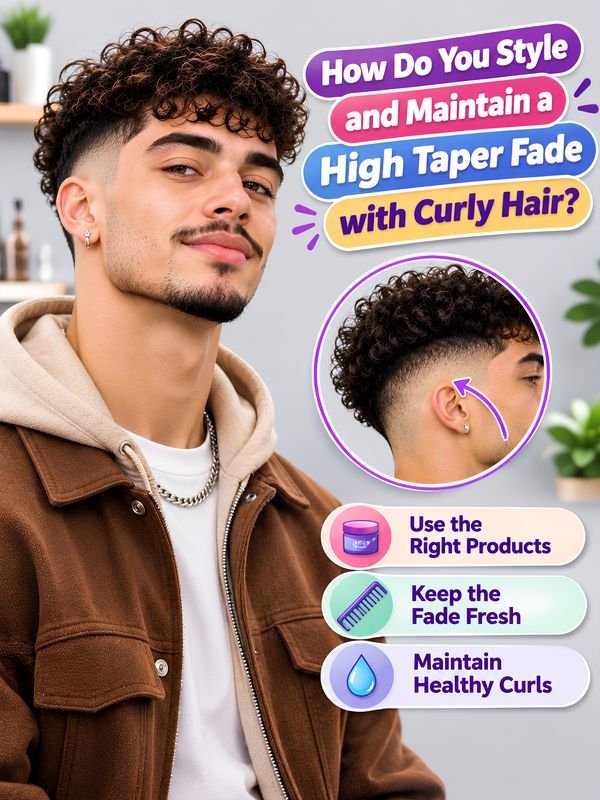
Maintenance splits into two jobs on two different clocks. Curl care on top is a weekly habit, while the taper itself only needs attention when the contrast softens, which is usually a matter of weeks rather than days.
Styling is easy once the cut is right. Apply a leave-in conditioner or curl cream on damp hair, scrunch gently, and let the curls dry naturally or with a diffuser. Thick hair may need a light gel for hold, while wavy texture often needs only a cream, which is why this high taper fade curly hair low maintenance routine suits busy men.
Curl care between haircuts
Curly and coily hair runs drier than straight hair, so the routine matters more here. These four habits cover most of it:
- Wash on need, not schedule: every few days to once a week. Over-washing leaves curls dry and hard to manage.
- Detangle while damp: use a leave-in conditioner and a wide-tooth comb or your fingers, working in sections. Brushing dry hair breaks it.
- Condition the full length: not just the ends, then seal with a light oil or leave-in.
- Protect it overnight: a satin cap or loose pineapple ponytail cuts friction against the pillow.
How often should you refresh the taper?
There is no universal interval, but the arithmetic gives a starting point. Healthy hair grows about half an inch a month, roughly an eighth of an inch a week. Since an eighth of an inch is a #1 guard, a skin-finished temple sits around #1 length after one week and #2 length after two.
That is why a sharp high taper fade usually needs a refresh about every two weeks, while a low taper can stretch to three or four. Go by what you see, such as a softening temple line, a filled-in nape, or a line-up losing its edge. If only the edges have gone fuzzy, ask for a neckline and temple trim instead of a full reblend.
What can go wrong with a high taper fade on curly hair?
Most problems are cosmetic rather than medical. A taper taken higher than intended, more scalp on show than you wanted, or a top thinned too aggressively for the sides are the usual complaints, and all are avoidable if you name the placement and the finish before the cut begins.
The exception is irritation from a very close finish at the neckline and temples, which is worth understanding before you ask for skin. If your skin is sensitive, a shadow finish or a guard length keeps the contrast while making the grow-out far more comfortable.
Must Read This 16 Best Mid Taper Fade Short Hair Styles for Men (2026)
Razor bumps, irritation, and breakage
Cutting coarse, curly hair very short is the mechanism behind razor bumps. Shortened hairs of this type can curve back into the skin as they grow, and the skin reacts to the ingrown hair. That is why barbers often steer bump-prone clients toward a shadow finish, and why repeated passes over the same close-cut patch are worth avoiding.
Bumps that persist on the back of the neck or scalp deserve a dermatologist’s opinion rather than a home remedy, since some conditions in that area look like razor bumps but can worsen without treatment and leave scars or permanent hair loss. On the hair itself, dryness and rough detangling do more damage than the fade does, so the curl-care routine above is the best prevention.
High, mid, or low taper for curly hair?
Choose by how much contrast and side fullness you want, not by treating one height as better than the others. A high taper gives the sharpest definition and shows regrowth fastest, a low taper is the most conservative and the easiest to keep, and a mid taper sits between them.
When comparing a high taper fade vs low taper on curly hair, think about your hairline, your lifestyle, and your top length. If you are unsure, start with a mid taper and go higher next visit, since it is much easier to go higher than to grow the sides back. The table shows the differences at a glance.
| Feature | High taper | Mid taper | Low taper |
|---|---|---|---|
| Side weight kept | Least | Moderate | Most |
| Contrast | Highest | Balanced | Subtle |
| Scalp visibility | Most | Low to moderate | Least |
| Grow-out visibility | Most noticeable | Moderate | Least noticeable |
| Refresh for a sharp look | About every 2 weeks | Every 2 to 3 weeks | Every 3 to 4 weeks |
Frequently asked questions
Can you get a high taper fade without going to skin?
Yes. A shadow finish or a #1 or #2 guard gives the same high placement with less scalp exposure and a softer grow-out.
Does a high taper fade work on thick or wavy curly hair?
Yes. Thick hair gives a sharper gradient, and wavy texture holds a medium top well, so both suit this cut.
Will a high taper fade suit round, oval, or square faces?
Yes. A taller curly top adds length for round faces, and oval and square faces suit most versions.
Can a high taper work with a receding or uneven hairline?
Yes. Soften the front edge instead of cutting a hard line-up, and consider a shadow finish.
Can you keep a curly fringe with a high taper?
Yes. The taper only shapes the edges, so leave the fringe slightly longer to allow for shrinkage.
Is a high taper fade suitable for boys and teenagers?
Yes. Keep the sides a little longer and choose a soft finish for a neat, low-risk school-friendly cut.
How do you avoid razor bumps around a close taper?
Choose a shadow over skin, avoid repeated passes, and moisturize. See a dermatologist if bumps persist.
Can you grow a high taper out into fuller sides?
Yes. Skip the sharp refreshes and trim only the neckline while the sides fill in over a few weeks.
Conclusion
A high taper fade on curly hair gives you a sharp outline, a full curly top, and a look that works for short curls, coils, waves, and long natural curls alike. It is flexible enough to carry a fringe, an afro, twists, a mohawk, a razor design, or bold color. What makes it work is the blend, so name the placement and the finish clearly before the clippers start, and remember that curls shrink as they dry.
To keep the taper fade looking its best, pair a refresh every two weeks with a simple curl-care routine of moisture, gentle detangling, and night protection. If your skin is sensitive, a shadow finish keeps the contrast without the irritation. Bring reference photos, use the five-point checklist, and choose the height that fits your lifestyle, and this will be one of the easiest, most stylish curly cuts for men in 2026.
